Future Network-5G
Category : Technology & Science | Sub Category : Technology Posted on 2020-04-03 06:20:45
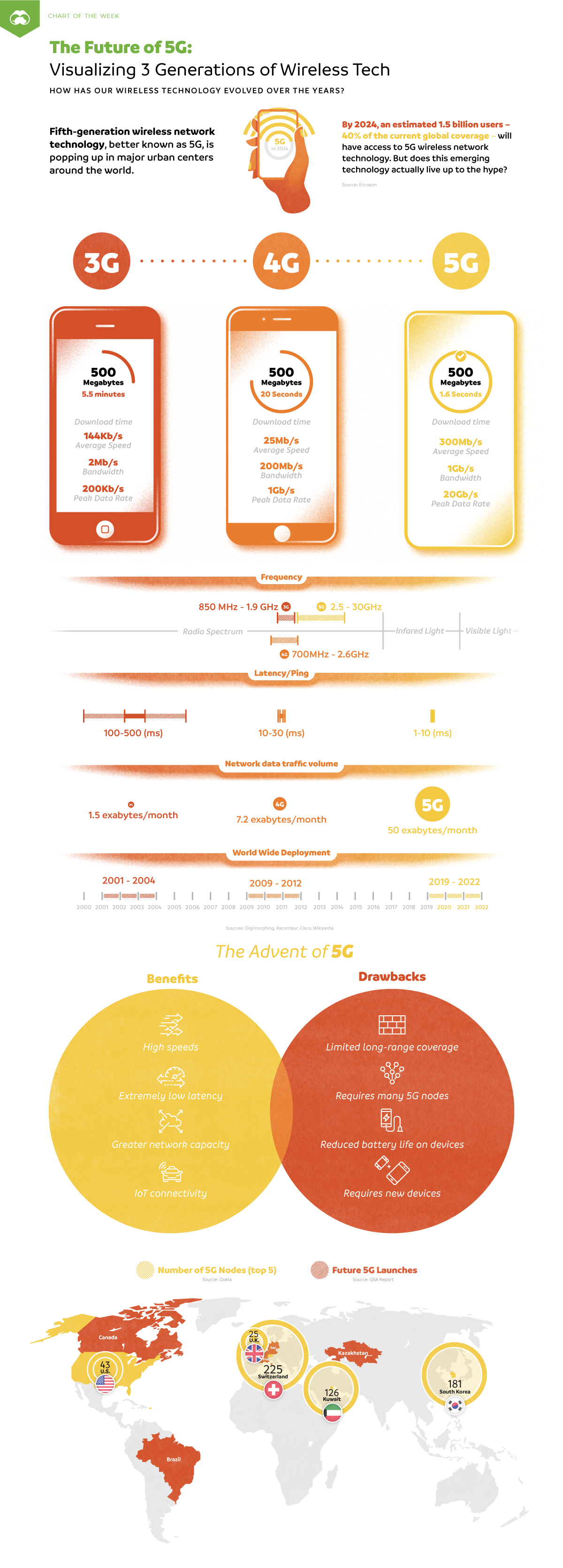
The Future of 5G: Comparing 3 Generations of Wireless Technology
Wireless technology has evolved rapidly since the turn of the century. From voice-only 2G capabilities and internet-enabled 3G, today’s ecosystem of wireless activity is founded on the reliable connection of 4G.
Fifth-generation wireless network technology, better known as 5G, is now being rolled out in major cities worldwide. By 2024, an estimated 1.5 billion mobile users─which account for 40% of current global activity─will be using 5G wireless networks.
Today’s chart highlights three generations of wireless technology in the 21st century, and the differences between 3G, 4G, and 5G networks.
5G: The Next Great Thing?
With over 5 billion mobile users worldwide, our world is growing more connected than ever.
Data from GSMA Intelligence shows how rapidly global traffic could grow across different networks:
- 2018: 43% of mobile users on 4G
- 2025: 59% of mobile users on 4G, 15% of mobile users on 5G
But as with any new innovation, consumers should expect both positives and negatives as the technology matures.
Benefits
- IoT Connectivity
5G networks will significantly optimize communication between the Internet of Things (IoT) devices to make our lives more convenient. - Low latency
Also known as lag, latency is the time it takes for data to be transferred over networks. Users may see latency rates drop as low as one millisecond. - High speeds
Real-time streaming may soon be a reality through 5G networks. Downloading a two-hour movie takes a whopping 26 hours over 3G networks and roughly six minutes on 4G networks─however, it’ll only take 3.6 seconds over 5G.
Drawbacks
- Distance from nodes
Walls, trees, and even rain can significantly block 5G wireless signals. - Requires many nodes
Many 5G nodes will need to be installed to offer the same level of coverage found on 4G. - Restricted to 5G-enabled devices
Users can’t simply upgrade their software. Instead, they will need a 5G-enabled device to access the network.
Global 5G Networks
5G still has a way to go before it reaches mainstream adoption. Meanwhile, countries and cities are racing to install the infrastructure needed for the next wave of innovation to hit.
Since late 2018, over 25 countries have deployed 5G wireless networks. Notable achievements include South Korea, which became the first country globally to launch 5G wireless technology in April 2019. Switzerland boasts the highest number of 5G network deployments, currently at 225 and counting.
To date, China has built roughly 350,000 5G sites─compared to the less than 20,000 in the U.S.─and plans to invest an additional US$400 billion in infrastructure by 2023. Chinese mobile providers plan to launch 5G services starting in 2020.
What Does This Mean For 4G?
4G isn’t going anywhere anytime soon. As 5G gradually rolls out, 4G and 5G networks will need to work together to support the wave of IoT devices entering the market. This network piggybacking also has the potential to expand global access to the internet in the future.
The race to dominate the wireless waves is even pushing companies like China’s Huawei to explore 6G wireless innovation─before they’ve even launched their 5G networks.
Search

Categories
Recent News
- Future Network-5G
- Most downloaded apps in the World
- Internet of Things Role in Building Smart Cities
- Technology role in shaping the future World
- Online Teaching and Learning tools suggested by UNESCO
- Technology Role in Shaping the Future of Education
- The Coronavirus Explained, and What You Should Do
- Aarogya Setu -app launched by Govt. of INDIA to fight against COVID-19